Links
http://openrocket.info/documentation.html
¶ Models Used
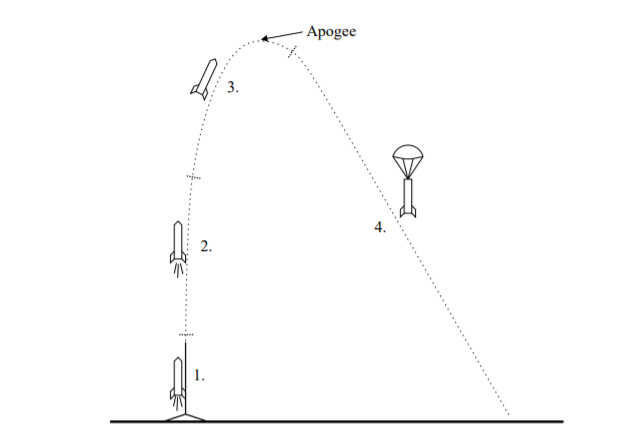
- Flight of a model rocket generally includes four phases: Launch, Powered Flight, Coasting Flight and Recovery and operates with 6 degrees of freedom.
- (3.1.2) Analytical prediction of aerodynamic properties in the transonic region, this region will be accounted for by interpolation that fairly closely resembles the actual measurements.
- (3.1.4) Fixed coordinate system is used at the nose cone tip with the positive x-axis directed down the centre of the rocket. The x and y axes are fixed in relation to the rocket and do not necessarily align with the plane of the pitching moments.
-
(3.2) In order to locate the Centre of Pressure of the rocket, OpenRocket makes assumptions based on Barrowman's method. These are:
- 1. The angle of attack is very close to zero. Since OpenRocket primarily looks at subsonic flow, the normal force and pitching moments are assumed to be equal when subsonic and supersonic.
- 2. The flow around the body is steady and non-rotational.
- 3. The rocket is a rigid body.
- 4. The nose tip is a sharp point.
- 5. The fins are flat plates. Fins with jagged edges are corrected so that the fin is one continuous shape, hence correcting the CP's position slightly backwards. This, however, is just an approximation and it is suggested that it should be avoided since there is often some interference factor between the two sections, this makes simulations inaccurate, so OpenRocket recommends to avoid awkwardly shaped fins as such. OpenRocket makes more accurate calculations when the number of fins on the rocket is either 3 or 4. Other numbers of fins make use of interpolation rather than direct calculations.
- 6. The rocket body is axially symmetric.
- 7. The rocket body is smooth and continuous
- (3.4.1) The boundary layer is assumed to be fully turbulent.
- (4.1.1)The model of the atmosphere is designed to evaluate the conditions at specific heights which may affect the Mach number calculated. Thus, in OpenRocket the models are built on the ideal gas law. OpenRocket allows users to input conditions of the launch site. Since it expects that the apogee would be a few kilometres, launch site conditions would dominate the flight.
- (4.1.1) The humidity is ignored as the differences in density and speed of sound between dry and wet air is less than 1%.
- (4.1.2) As wind always has a certain degree of turbulence in it the effect of turbulence is modelled by summing the steady flow of air and a random zero-mean turbulence velocity. Two key aspects of the turbulence velocity are the amplitude of the variation and frequencies at which they occur. So a reasonable turbulence model is created by a random process which creates a sequence with a similar distribution and frequency spectrum to that of real wind. As the time scale of a model rocket's flight is generally quite short, the effect of extremely low turbulence frequencies can be ignored and the turbulence modelled using pink noise.
- (4.2.0) OpenRocket assumes that since most model rockets fly to an apogee of a few kilometres, the curvature of the Earth is not taken into account. Assuming a flat Earth allows OpenRocket to use simple Cartesian coordinates to represent the position and altitude of the rocket. As a consequence, when flying long distances north or south, the Coriolis effect is not simulated either.
- (4.2.1) The wind is assumed to be unidirectional and the Coriolis effect is ignored. Specifically, the wind would be along the x-axis while xy-plane is parallel to the ground. The angles of launch rods are relative to the wind directions.
- (4.2.1) Two ways are introduced to determine the orientation of a rocket: spherical coordinate ( θ , φ ) and Euler's rotation theorem. For both solutions, the singularity points with ambiguous values in some parameters may prone to programming errors. One more constraint is added to eliminate the singularity in spherical coordinates. Either a unit quaternions can be simple and efficient to describe the 3D rotation. The orientation of the rocket is stored as a unit quaternion that rotates the rocket from reference orientation to the current one.
- (4.2.5) During recovery simulation, the simulation changes to three degrees of freedom instead of six. This is because once the parachute is deployed and the rocket body splits into two it is no longer practical to compute the rocket's orientation.
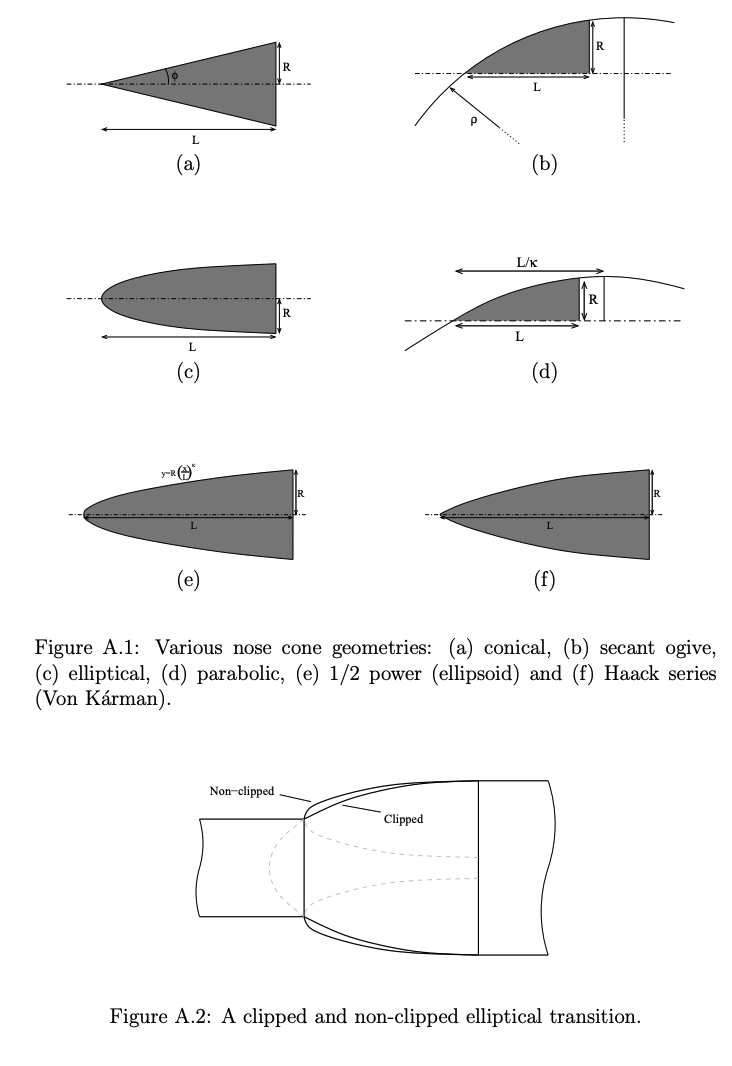
NOSE CONE GEOMETRIES
¶ Model Limitations
(5.1.2) To solve the differential equations associated with fluid simulation Runge-Kutta 4 (4th order) numerical methods are used.
(5.1.2) The basis for aerodynamics calculations are the Barrowman Equations, which can provide the location of the coefficient of pressure (C_p) given a large set of inputs. This is crucial in determining the dimensionless stability of the rocket.
(5.1.4) The model assumes a smooth, continuous rocket body, i.e. no breaks which would cause extra drag.
(4.1.2) Turbulence and wind patterns are simulated with white noise signals produced from random data sets in combination with IIR (infinite impulse response) filters to produce turbulence spectra. Wind speed is set as constant
(4.2.5) Drag coefficient is estimated with an accuracy of about 20%, which translates to a descent velocity accuracy within 15% of the true value
¶ Strengths and Shortcomings
STRENGTHS
- Uses many direct calculations and numerical methods for properties such as drag, Reynolds number, Cente of Pressure, and other aerodynamic properties, which are decently accurate for Mach Numbers below 0.8, giving a reasonable range for model rocketry to be simulated accurately.
- (7) Very experimental for those willing to play around with the software, also has a simple user interface.
- (7) Open source! Anyone with enough knowledge can create modifications to the software and help to improve its working environment.
- The six degrees of freedom simulator allows rocket roll to be simulated so that the effects of roll stabilisation, a feature not available in other hobby-level rocket simulators. (However accuracy of roll simulation is yet to be confirmed)
- (5.2) Multiple simulations can be run at once within the software, the simulations also greatly aide in the analysis of the model's performance and can help to identify problems.
- Simulation listeners included in the software so that when the simulations run, the listeners perform internal calculations and calculate external flight data to what is being analysed, allowing for complete control over how simulations run.
- See drag estimation and CP location analysis in Simulation vs Experimental Data .
- Both flight and recovery can be simulated!
SHORTCOMINGS
- (3.1.2) Due to the fact that interpolation is used for transonic flight, the is no way to tell if the simulations run by models that go past Mach 0.8 are legitimate or at all accurate to real circumstances. Supersonic and Hypersonic flights are barely considered in OpenRocket since no model or high power rockets will reach this speed.
- (4.2.1) The calculation of orientation may be different if the launch pad is not completely vertical.
- (7) CP location and drag coefficient estimated to an accuracy of 10% from the original value at subsonic velocities and deviates even further as the Mach number increases.
- See solid rocket, hybrid rocket, and normal forces analysis in Simulation vs Experimental Data .
¶ Simulation vs Experimental Data (6)
Note: the figures given in this section derives from data found in experiments using a specific configuration of rockets, therefore the numbers should not be applied blindly, but merely use as a guideline
SOLID ROCKET
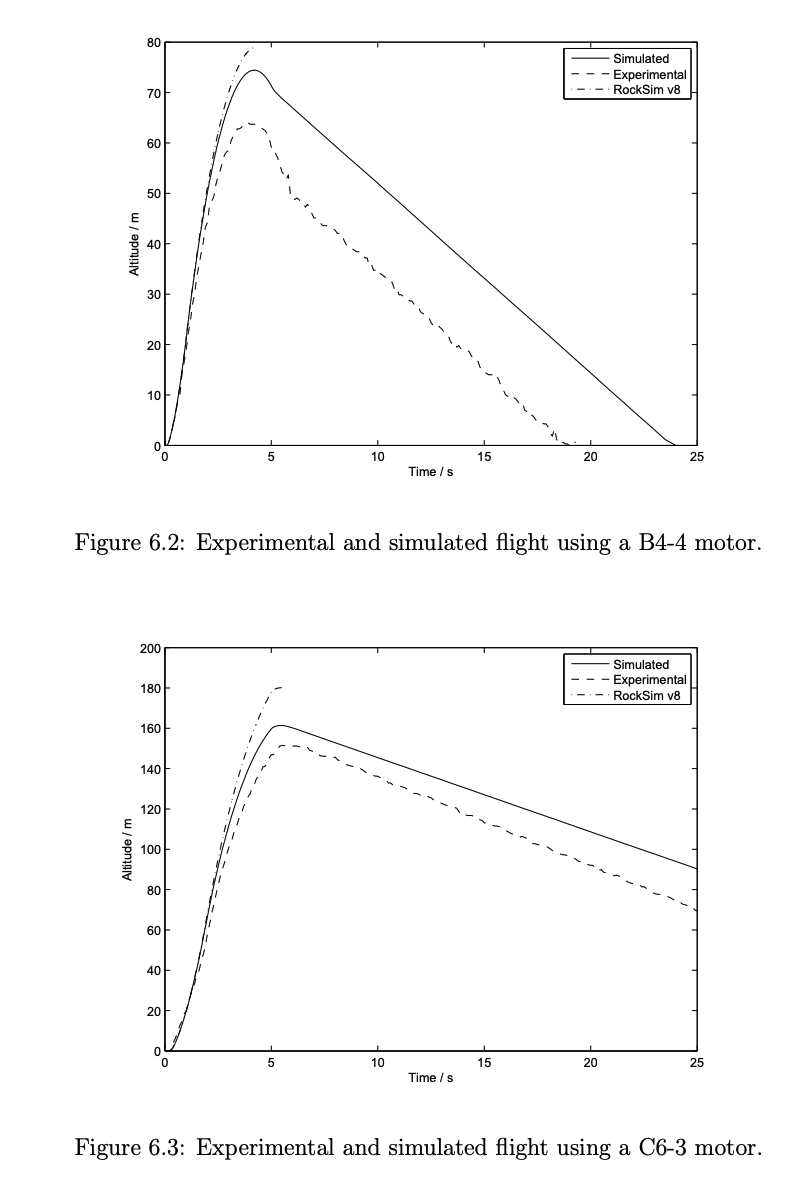
- OpenRocket overestimates apogee - by 16% when using a B4-4 motor and by 7% when using a C6-3 motor.
- The error in the descent speeds are 7% and 13% respectively.
HYBRID ROCKET
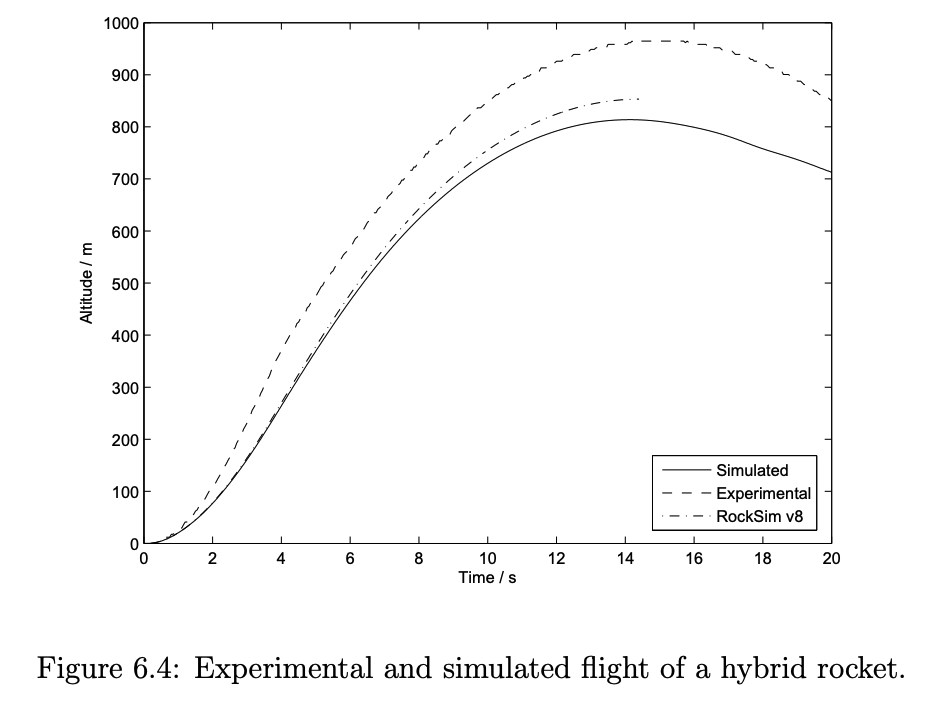
- OpenRocket underestimates apogee - by 16%.
- The vapour pressure of the nitrous oxide is highly dependent on temperature, which affects the thrust of the motor. This may cause some variation in the thrust between true flight and motor tests.
ROLLING ROCKET - EXPERIMENT WAS INACCURATE!
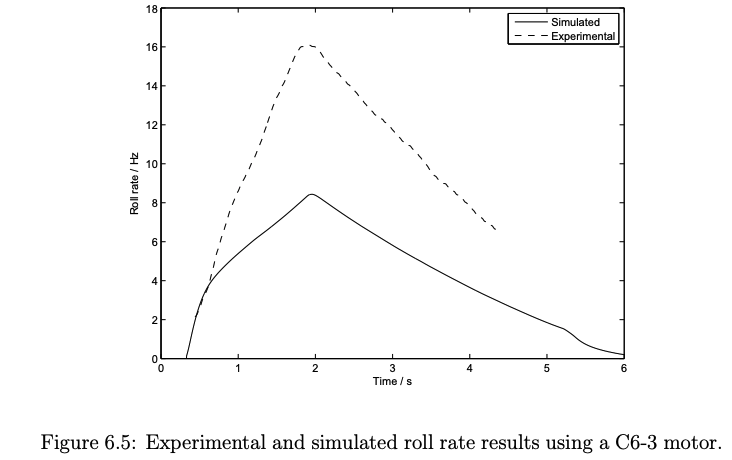
- The rocket had 5 degrees canted fins.
- Simulated roll rate was doubled that of experimental - but the test rocket fin was found to be bent :o
AXIAL FORCES, CP, AND NORMAL FORCES (Wind tunnel test)
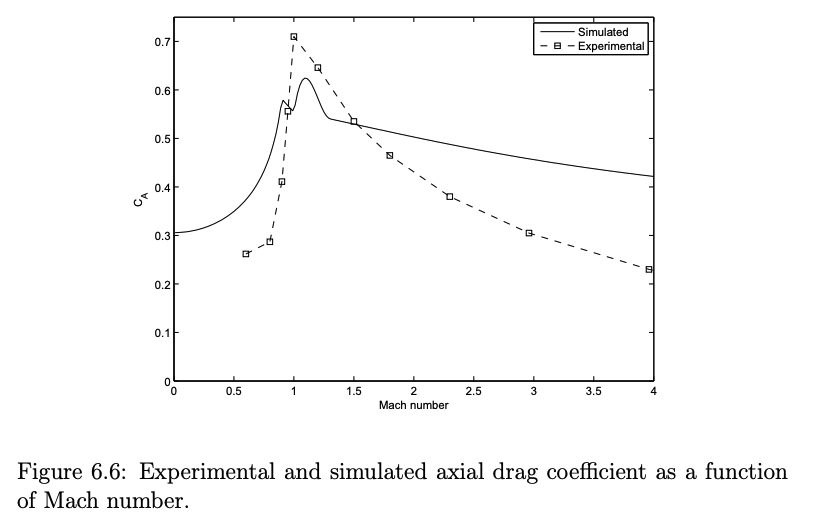
- Overall, the drag estimation matches reasonably.
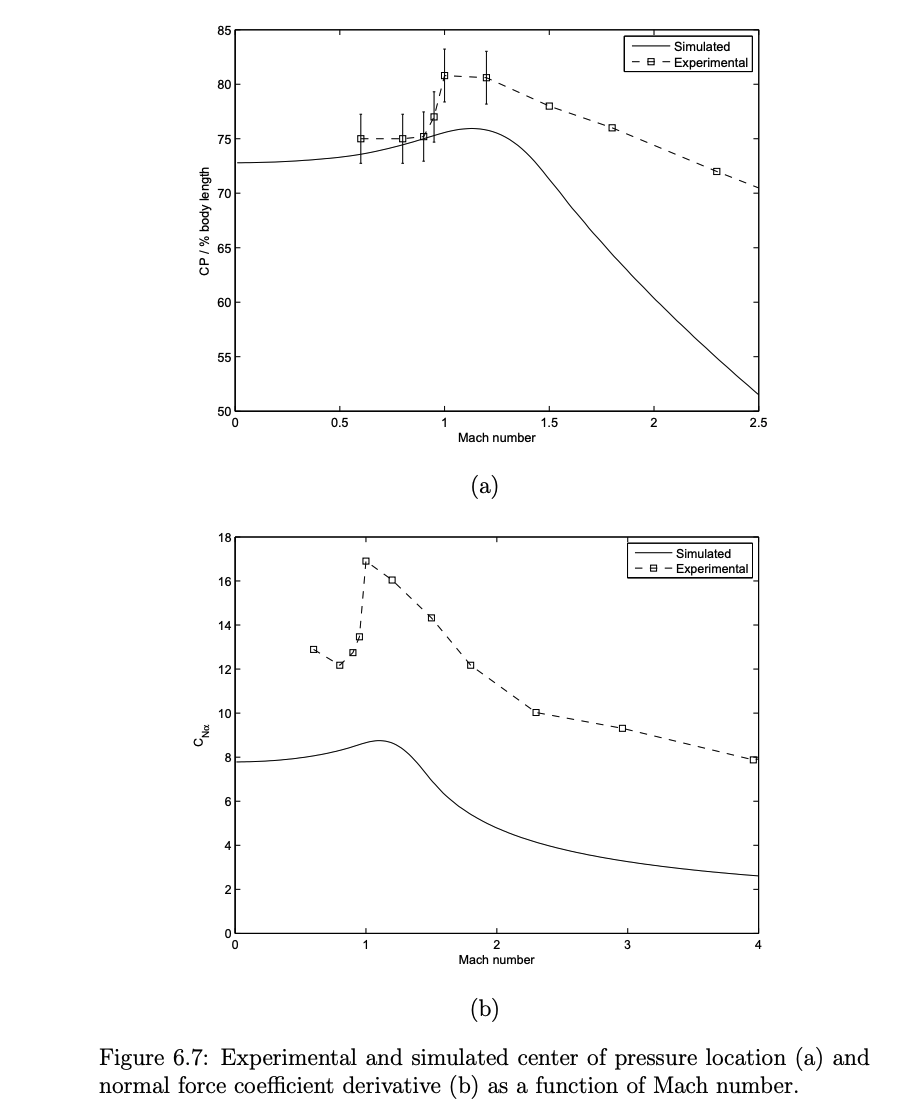
- CP location matches to within a few percents at the subsonic region.
- As Mach increases, OpenRocket CP location estimation becomes too pessimistic.
- OpenRocket CP location estimation is reasonable up until Mach 1.5.
- OpenRocket simulated normal force coefficient derivative is much lower than experimental values.
- The effect of the lower normal force coefficient on a flight simulation is that the rocket corrects its orientation slightly slower than in reality
- The effect on the flight altitude is considered to be small for typical stable rockets.